
Take a closer look at refractive errors

Discover how refractive errors affect your sight and how advanced refractive procedures can address them in Windhoek.

Take a closer look at refractive errors

Discover how refractive errors affect your sight and how advanced refractive procedures can address them in Windhoek.

Discover what’s behind the way you see

Learn how refractive errors can affect your vision and explore how modern treatment options can address them.

Refractive errors occur when the shape of the eye prevents light from focusing correctly on the retina. This can cause your vision to appear blurred or out of focus. Common refractive errors include myopia (short-sightedness), hyperopia (long-sightedness), astigmatism and presbyopia. Depending on the type and severity of the refractive error, you may have difficulty seeing objects clearly at a distance, close up, or at both distances. An eye examination can determine whether a refractive error is affecting your vision and help identify the most appropriate options for managing it.
There are several types of refractive errors, and each affects vision in a different way. Myopia makes distant objects appear blurred, while hyperopia can make close objects difficult to see clearly. Astigmatism occurs when the eye has an irregular shape, which can cause blurred or distorted vision at different distances. Presbyopia is an age-related change that makes it harder to focus on nearby objects. Some people may have more than one refractive error at the same time. Understanding which type you have is an important part of finding an appropriate treatment or vision correction option.
Refractive errors occur when the shape or length of the eye affects the way light is focused onto the retina. Genetics can play a role, so refractive errors can sometimes run in families. Age can also influence how the eye focuses, particularly with presbyopia. In some cases, changes in the eye can alter the way you see over time. Having a refractive error does not necessarily mean that there is a disease affecting your eyes. However, changes in vision should be assessed by an eye care professional so that the cause can be identified and any appropriate treatment options can be discussed.
A comprehensive eye examination can identify whether a refractive error is affecting your vision. Your ophthalmologist may assess how clearly you can see at different distances and measure how your eyes focus light. Additional examinations or imaging may be recommended depending on your individual circumstances and the treatment options being considered. An assessment can also help distinguish a refractive error from other conditions that may cause changes in vision. At Namibia Eye Institute, advanced diagnostic and surgical technology is available in Windhoek, supporting personalised assessment and treatment planning.
Yes, some refractive errors can be treated with vision correction surgery. These procedures are designed to change the way the eye focuses light, helping to correct problems such as short-sightedness, long-sightedness and astigmatism. Depending on your individual circumstances, surgery may reduce your reliance on glasses or contact lenses. However, not everyone is suitable for every type of procedure. Your prescription, eye health, age and other factors will be considered during an assessment to determine whether vision correction surgery could be an appropriate option for you. Vision correction procedures like lens replacement and cataract surgery are available in Windhoek at Namibia Eye Institute.
Yes, your vision can change over time, and the type or strength of a refractive error may change as well. Myopia, hyperopia and astigmatism can change throughout life, while presbyopia is a natural age-related change that affects the eye’s ability to focus on nearby objects. Changes in your prescription do not necessarily mean that something is wrong with your eyes, but a noticeable change in vision should be assessed by an eye care professional. Regular eye examinations can help monitor your vision and identify whether your changing sight is due to a refractive error or another eye condition.
A refractive treatment consultation is an opportunity to understand what is affecting your vision and discuss the options available to you. Your ophthalmologist will assess your eyes and consider factors that may affect your suitability for treatment. You can also discuss your visual needs, expectations and any questions you have about the procedure. If treatment is considered appropriate, your ophthalmologist can explain the recommended approach, potential benefits and relevant risks. At Namibia Eye Institute, treatment planning is centred on personalised care and the use of modern diagnostic and surgical technology in Windhoek.

Take the first step towards clearer, healthier vision

Request an appointment to understand your eyes, explore your options and find out what treatment may be right for you.

Take the first step towards clearer, healthier vision

Request an appointment to understand your eyes, explore your options and find out what treatment may be right for you.

See your best in 3 simple steps 

Your eye health matters. We make your journey from your first assessment to better vision clear, simple and personal

Step 1: Get in touch

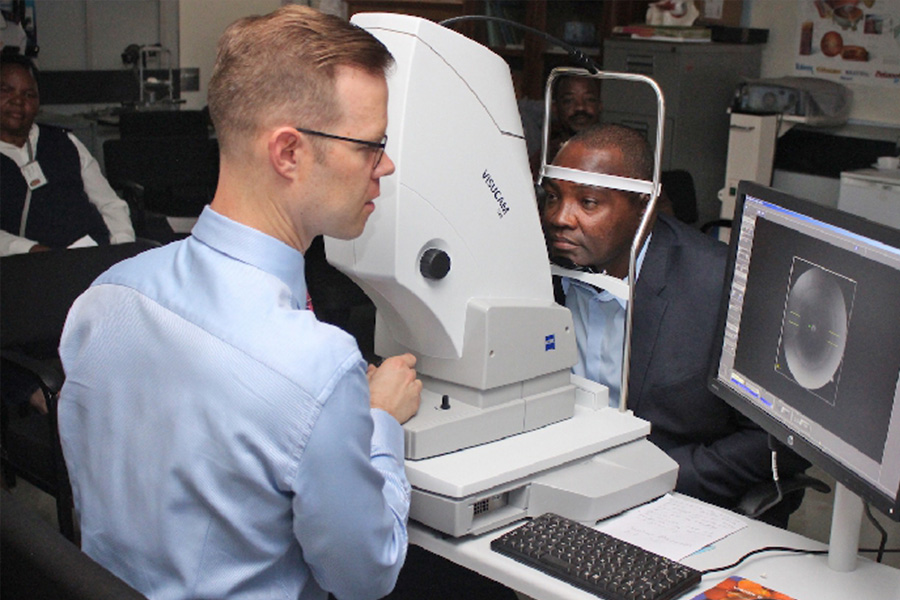
Every pair of eyes is different, so the right treatment depends on your vision, eye health, lifestyle and goals. Get in touch with our friendly team to arrange your initial assessment and find out how we can help.

Step 2: We’ll meet 

At your assessment, we’ll take the time to understand your needs and examine your eyes in detail. We’ll explain your options, answer your questions and recommend the most suitable treatment for you. You’ll leave with a clear understanding of the next step and what to expect.

Step 3: Enjoy Freedom

Once your treatment is complete, you can look forward to the lasting benefits of clearer, more comfortable vision. Whether your goal is greater freedom from glasses, improved everyday vision or better eye health, we’re here to support you throughout your journey.

The difference better vision can make

Discover how the right eye care has helped our patients see and live with greater confidence.

We have replaced the images of real patients who provided these testimonials to protect their privacy.

Could you be free from glasses and contacts?

Find out if vision correction surgery could be right for you with our free 2-minute self-test.

Could you be free from glasses and contacts?

Find out if vision correction surgery could be right for you with our free 2-minute self-test.

Dr  Sven  Obholzer

MBChB (Stell), MMed Ophth (Stell), FC Ophth (SA)

I’m a specialist ophthalmologist with more than 14 years of experience in eye care and microsurgery. I trained at Stellenbosch University and Tygerberg Hospital in Cape Town, where I completed my Master’s Degree in Ophthalmology and Fellowship of the College of Ophthalmologists of South Africa. My main areas of interest include retinal surgery, cataract surgery and anterior segment surgery. As founder of the Namibia Eye Institute, I use modern surgical techniques and advanced technology. My focus is simple: to provide careful, evidence-based treatment that is tailored to each patient.